9. Sulci Identification Workflow
9.1. Introduction
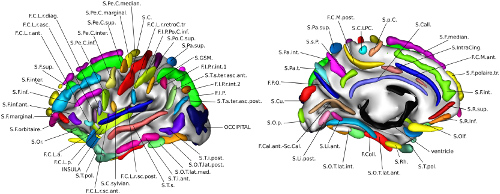
Preprocessing MRI data is a crucial step in transforming raw scanner outputs into signals that can be meaningfully interpreted and compared across individuals. This task is especially complex when studying the human brain folding patterns. Every person’s folding pattern is unique, like a fingerprint. The primary challenge is that these folds (sulci) change shape, split, or merge drastically from one person to another. Successfully mapping these folds is of scientific and clinical interest; by precisely measuring their depth and width, doctors can spot early brain shrinking in diseases like Alzheimer’s. Furthermore, accurate sulcal mapping helps scientists understand how the brain develops.
9.2. Requirements
CPU |
RAM |
|---|---|
1 |
1 GB |
9.3. Description
Processing Steps
This analysis relies on morphologist’s pipeline [1].
Automate High‑Quality Brain Segmentation The preprocessing performs full anatomical segmentation of T1 MRI data, including gray matter, white matter, and cerebrospinal fluid. This provides the foundation for downstream morphometric analyses.
Extract and Analyze Cortical Surfaces The tool reconstructs cortical surfaces and generates meshes.
Perform Detailed Sulcal Morphometry The sulcal analysis, includes sulcus recognition (now CNN‑based), sulcal depth, length, and span, gyrification index, and cortical fold graph construction.
Quality Control:
Sulcal Morphometry scores Images were classified as motion outliers when they exceeded established thresholds for these metrics. Specifically, any volume with a mean framewise displacement greater than 0.2 mm, or with a mean standardized DVARS value exceeding 1.5, was flagged as low‑quality.
Manual inspection Subject‑level quality‑control HTML reports are reviewed manually to ensure that preprocessing outcomes are consistent across participants and that no systematic artifacts remain.
9.4. Outputs
The sulcirec directory contains subject-level results, logs, and
quality-control outputs.
The structure is organized following the brainprep ontology.
sulcirec/
├── dataset_description.json
└── subjects
    └── sub-01
        └── ses-00
            ├── log
            │   └── report_20260409_112204.rst
            └── run-28236
                ├── anat
                │   ├── folds
                │   │   └── 3.1
                │   │       ├── sub-01_ses-00_run-28236_hemi-L.arg
                │   │       ├── sub-01_ses-00_run-28236_hemi-L.data
                │   │       │   ├── aims_Tmtktri.gii
                │   │       │   ├── bottom_Bucket.bck
                │   │       │   ├── cortical_Bucket.bck
                │   │       │   ├── junction_Bucket.bck
                │   │       │   ├── other_Bucket.bck
                │   │       │   ├── plidepassage_Bucket.bck
                │   │       │   └── ss_Bucket.bck
                │   │       ├── sub-01_ses-00_run-28236_hemi-L_sulcivoronoi.nii.gz
                │   │       ├── sub-01_ses-00_run-28236_hemi-R.arg
                │   │       ├── sub-01_ses-00_run-28236_hemi-R.data
                │   │       │   ├── aims_Tmtktri.gii
                │   │       │   ├── bottom_Bucket.bck
                │   │       │   ├── cortical_Bucket.bck
                │   │       │   ├── junction_Bucket.bck
                │   │       │   ├── other_Bucket.bck
                │   │       │   ├── plidepassage_Bucket.bck
                │   │       │   └── ss_Bucket.bck
                │   │       ├── sub-01_ses-00_run-28236_hemi-R_sulcivoronoi.nii.gz
                │   │       └── sul-0_auto
                │   │           ├── sub-01_ses-00_run-28236_sul-0_auto_sulcal_morphometry.csv
                │   │           ├── sub-01_ses-00_run-28236_sul-0_hemi-L_auto.arg
                │   │           ├── sub-01_ses-00_run-28236_sul-0_hemi-L_auto.data
                │   │           │   ├── aims_Tmtktri.gii
                │   │           │   ├── bottom_Bucket.bck
                │   │           │   ├── cortical_Bucket.bck
                │   │           │   ├── junction_Bucket.bck
                │   │           │   ├── other_Bucket.bck
                │   │           │   ├── plidepassage_Bucket.bck
                │   │           │   ├── ss_Bucket.bck
                │   │           ├── sub-01_ses-00_run-28236_sul-0_hemi-R_auto.arg
                │   │           └── sub-01_ses-00_run-28236_sul-0_hemi-R_auto.data
                │   │               ├── aims_Tmtktri.gii
                │   │               ├── bottom_Bucket.bck
                │   │               ├── cortical_Bucket.bck
                │   │               ├── junction_Bucket.bck
                │   │               ├── other_Bucket.bck
                │   │               ├── plidepassage_Bucket.bck
                │   │               └── ss_Bucket.bck
                │   ├── mesh
                │   │   ├── sub-01_ses-00_run-28236_head.surf.gii
                │   │   ├── sub-01_ses-00_run-28236_hemi-L_pial.surf.gii
                │   │   ├── sub-01_ses-00_run-28236_hemi-L_white.surf.gii
                │   │   ├── sub-01_ses-00_run-28236_hemi-R_pial.surf.gii
                │   │   └── sub-01_ses-00_run-28236_hemi-R_white.surf.gii
                │   ├── segmentation
                │   │   ├── sub-01_ses-00_run-28236_brain.nii.gz
                │   │   ├── sub-01_ses-00_run-28236_edges.nii.gz
                │   │   ├── sub-01_ses-00_run-28236_hemi-L_cortex.nii.gz
                │   │   ├── sub-01_ses-00_run-28236_hemi-L_csf.nii.gz
                │   │   ├── sub-01_ses-00_run-28236_hemi-L_grey_white.nii.gz
                │   │   ├── sub-01_ses-00_run-28236_hemi-L_gw_interface.nii.gz
                │   │   ├── sub-01_ses-00_run-28236_hemi-L_roots.nii.gz
                │   │   ├── sub-01_ses-00_run-28236_hemi-L_skeleton.nii.gz
                │   │   ├── sub-01_ses-00_run-28236_hemi-R_cortex.nii.gz
                │   │   ├── sub-01_ses-00_run-28236_hemi-R_csf.nii.gz
                │   │   ├── sub-01_ses-00_run-28236_hemi-R_grey_white.nii.gz
                │   │   ├── sub-01_ses-00_run-28236_hemi-R_gw_interface.nii.gz
                │   │   ├── sub-01_ses-00_run-28236_hemi-R_roots.nii.gz
                │   │   ├── sub-01_ses-00_run-28236_hemi-R_skeleton.nii.gz
                │   │   ├── sub-01_ses-00_run-28236_hfiltered.nii.gz
                │   │   ├── sub-01_ses-00_run-28236_nobias.han
                │   │   ├── sub-01_ses-00_run-28236_nobias.his
                │   │   ├── sub-01_ses-00_run-28236_nobias.nii.gz
                │   │   ├── sub-01_ses-00_run-28236_skull_stripped.nii.gz
                │   │   ├── sub-01_ses-00_run-28236_sul-0_brain_volumes.csv
                │   │   ├── sub-01_ses-00_run-28236_variance.nii.gz
                │   │   ├── sub-01_ses-00_run-28236_voronoi.nii.gz
                │   │   └── sub-01_ses-00_run-28236_whiteridge.nii.gz
                │   ├── sub-01_ses-00_run-28236_sul-0_morphologist_report.json
                │   ├── sub-01_ses-00_run-28236_sul-0_morphologist_report.pdf
                ├── qc.tsv
                ├── registration
                │   ├── sub-01_ses-00_run-28236_T1w.referential
                │   ├── sub-01_ses-00_run-28236_T1w_TO_MNI152.trm
                │   └── sub-01_ses-00_run-28236_T1w_TO_Talairach-ACPC.trm
                ├── sub-01_ses-00_run-28236.APC
                ├── sub-01_ses-00_run-28236_desc-conform_T1w.nii.gz
                ├── sub-01_ses-00_run-28236_normalized_SPM.nii
                ├── sub-01_ses-00_run-28236_sn.mat
                └── sub-01_ses-00_run-28236_sn_pass1.mat
Description of contents:
dataset_description.jsonMetadata describing the process, including versioning and processing information.log/report_<timestamp>.rstContains group-level workflow steps and parameters.quality_check/motion_confounds.tsvTable containing the mean standardized DVARS and mean FD for each subject/session/run. The table includes a binaryqccolumn indicating the quality control result.subjects/sub-<id>/ses-<id>/logs/report_<timestamp>.rstContains subject-level workflow steps and parameters.subjects/sub-<id>/ses-<id>/run-<id>Standard morphologist folder structure (https://brainvisa.info/axon-6.0/en/processes/categories/morphologist/category_documentation.html).
9.5. Featured examples

Sulci reconstruction Pre-Processing
Explore how to perform this analysis.